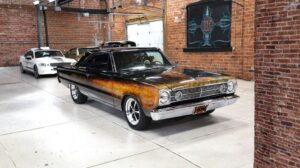
Lighter than a Camaro, far meaner than a Nova, and less expensive than both, the Plymouth Duster was introduced in 1970 as a cheap-thrills alternative for younger drivers who couldn’t afford the brawly and in-demand muscle cars like a Road Runner, Chevelle, or Mustang. It was a true underdog that the performance world seemed to overlook. Honestly, not much has changed in the last fifty-six years. This muscle car is still the best bang for your buck if you’re building a budget restomod.
But first, let’s look at the why before we venture into the how!
The Cool Factor
Let’s start with the fact that it’s a Mopar. Whether it’s lust or love that drives the value of a Dodge, Plymouth, or Chrysler through the stratosphere, the prices they demand leave no doubt that these brands are the most coveted of all the muscle cars. And this is the cheapest way into the party. Plus, it’s damn cool looking! Molded into a semi-fastback with sharp lines and unique features like a shark-nose grille and dual snout hoods, this car is built to have a bark as mean as its bite.
Weight Advantage
Plymouth introduced the Duster on the A-body platform. Unlike its heavyweight siblings, which easily tip the scales at 3,800 lbs or more, a Duster weighs around 2,900 to 3,100 lbs. That’s 700 to 900 lbs less or, theoretically, seven-tenths of a second advantage in a quarter-mile drag race (for every 100 lbs lost, you gain 1/10 of a second on the track). What that also means is that you don’t need 800 horsepower to feel alive when 350 to 400 horsepower will do the trick!
High Production Numbers – Lower Prices
The Duster was an overnight sensation for Plymouth. In 1970 alone, they rolled out over 217,000 units. The best part: they ran for six years and churned out 1,300,000 of them between ’70 and ’76! To make things better, they practically left design alone, so with minimal changes and massive production numbers, you have lower prices. So what’s it going to cost? Get ready to fork out a couple grand for a project; some examples of slant six grocery getters that are still gettin’ around have recently sold for only $5,000. Then there are examples of “good” condition 360 cars crossing the block for $20,000 or less.
Now that we’ve looked at why you should snag one of these machines and give it the restomod makeover it deserves, let’s take a look at how to do it the right way!
Drivetrain
Might as well kick this off with what feeds the beast! In reality, building from back to front is always the best option, but why save dessert for last? Because of its spacious engine bay and having rolled off the factory floor with rowdy 340s or 360s, it’s easy to get a fired-up motor between the fender wells.
- Bang for the buck: 318 or 360 LA Small Block: If minimum cost is your goal, then the LA motor is for you. The LA small block is known for its longevity and its ability to make enough power to light up the tires and your local police officers’ sirens as you rip by. First, source these small blocks (with many in junkyards or across marketplaces) for cheap. Refresh the bottom end, add high-flow heads, drop in an aluminum intake, then some headers, and nestle that motor into an engine bay built for that exact block, which will make all other parts cheaper to install. I know that we’re ballin’ on a budget here, but do yourself a favor and install an EFI kit with electronic ignition. We’re still shooting for reliability and drivability, and that’s an incredibly easy upgrade with great ROI. If you do most of the work and get creative, you can have a motor for $5,000.
- Old School Brawler: Now, let’s take a block built for the car so parts are accessible and cheap, then do something to the motor we all love: stroke it! Snag a clean 360 block and extend it out to 408 cubic inches. You’ll be grateful for the big block power- 450-plus horsepower- while optimizing power-to-weight ratios with aluminum heads and a radiator. Drop in a stroked-out small block with tire-shredding torque and enjoy the rest of your life for around $8,500 for a fully dressed 408.
- Modern Muscle: Dropping in a modern Gen III Hemi is the ultimate choice to push your Duster into a true and monstrous restomod. Luckily, there are many, many ways to get your hands on a 5.7, 6.2, or 6.4 Hemi. Whether you yank one from a modern Challenger or order a crate engine, you’ll be making a long-term investment in a family of motors that easily cross the 200,000-mile threshold while maintaining brutal power and respectable fuel mileage. And today, loads of companies offer conversion kits to make the transition as easy as possible. Prices vary depending on how you go about this, but be prepared to pay at least the same for a 318 LA motor and well into 5-digit territory if you wanna go bananas. Speed costs money, so how fast do you want to go?
- Shifting Gears: What you stick behind your V8 is all about preference and priorities. If you love the mechanical feeling of the original A833, then mount that 4-speed behind any of these options. If you need another gear to drop the RPM’s for highway cruising, look at a Tremec 5- or 6-speed to handle that for you. A 727 Torqueflight is a tried-and-true auto warrior. Need another gear? Check out Gear Vendors. Or, you can mount a modern automatic and get 3xs and many gears, as the car came with stock.
Handling & Braking
Mopars were notorious for having soft steering and feeling like you were floating more than driving. And this A-body is no exception. To hit those corners like you’re on rails, we need to address three areas immediately.
- Structural Rigidity: The Duster is a uni-body car, meaning that there is no frame that the body mounts to. All chassis and suspension are built into the body itself. Great for being lightweight but bad for body flex. Too much power and you’re twisting your floor pan. The easiest fix, and the best place to start, is subframe connectors. A pair will set you back roughly $200, and it’s worth every penny when you don’t see cracks in your fresh paint.
- Tubular Suspension & Steering Upgrade: Yes, you can drop $15,000 and buy a complete frame and suspension for your Duster. But since we’re on a budget, let’s stick to the basics. So install heavy-duty torsion bars and ditch the stock skimpy ones. Add tubular upper control arms to bring your alignment into this century. A quick ratio steering box is an understated performance upgrade. Once you replace the 16:1 steering ratio with a 12:1, or install a complete rack and pinion, you’ll hit corners with extreme confidence.
- Modern Disc Brakes: Dusters usually were offered with 4-wheel drum brakes or tiny 10” disc brakes up front and a set of drums in the rear. Upgrade your spindles and mount a set of 11” or 12” drilled and slotted rotors with multi-pistons up front and another set out back to ensure your Mopar comes to a prompt stop.
Interior Overhaul
Do you need a new interior to have a restomod? Not really. A couple of bucket seats, a windshield, gauges, and some tunes, and you’re cruising, baby! But to do a real restomod build and do your ride justice, it’s time for an update.
- Noise and Heat Insulation: Unless you have a pinch of insanity (I know I do), love the smell of burnt fuel, hot floorboards, and need a pair of earplugs to drive to the grocery store, you’re set. If any of these things sound like cruising won’t be as much fun, then lay down a solid barrier of sound-deadening mats. Roll them onto your floorboard, doors, back seat, and roof at a minimum.
- Modern Air Conditioning: Is it a must? Nope. But in 2026, AC has become less expensive, lighter, and far easier to install as a kit. So there’s really no reason not to treat yourself and your passengers and add some cool air to your interior.
- Update Your Gauge Cluster: The old mechanical gauges are known for their inaccuracies. So invest in an updated set of gauges for your Plymouth and never worry about a wrong temp reading again.
Wiring Update
Having seen someone’s recently restored ride go up in smoke, I can tell you that updating your wiring is non-negotiable for a restomod. Old wires are brittle, crack, and spark, which could lead to a potentially heartbreaking end to your budget Duster dreams. A quick search will give you a massive list of options to install brand-new wiring that’s built for your Duster. This is investing in your car and your peace of mind.
The Duster is without a doubt the best underdog muscle car on the market. So whether you build a dream car that’s built for showing off or a ratty restomod that is all go, it doesn’t matter. What matters is that you use what you have to save one of these special machines and then enjoy the hell out of it. That’s what they were built for, and that’s why we build them. So get out there, go cruising, and build something.